
DNA identifies Suraj Lama After Disappearance in Kochi, Prompting Inquiry into Custody Lapses
February 9, 2026

Organized crime has moved from street corners to encrypted chats and invite-only marketplaces. Dark web cartels and syndicates now lean on parcel shipping, crypto-based laundering (including mixers and privacy coins), and closed networks that mimic legitimate e-commerce, ratings, escrow, logistics included. Law enforcement lands big blows (Silk Road, AlphaBay, Hydra, SpecTor, RapTor), but the ecosystem regenerates fast. And the money trails, now often on-chain, remain trackable enough to yield high-impact seizures. Europol+2Europol+2Federal Bureau of Investigation
Dark-net “cryptomarkets” run by dark web cartels let vetted vendors sell everything from opioids to forged documents behind Tor, using escrow, vendor ratings, and dispute mediation. They function like professional e-commerce, just illicit. EMCDDA/Europol’s foundational study found drugs make up roughly two-thirds of listings, and EU-based sellers alone once accounted for ~46% of revenues across major markets studied. Europol
Why it works: Reputation systems reduce “rip-offs,” escrow lowers buyer risk, and global reach means sellers can move product without turf wars. The same report documents how takedowns disrupt but rarely dismantle the model; markets vanish, rebrand, or migrate. Europol
Instead of bulk smuggling, vendors ship thousands of micro-packages, pills, powders, through postal streams. During “Operation Porto,” German controls seized 6,000 drug-laden parcels tied to darknet sales, illustrating how letter-class shipments became a distribution backbone. In the U.S., Congress forced USPS to share advance electronic data on inbound mail to curb opioids; enforcement shifted the problem but showed how critical parcel post remains. EuropolGovernment Accountability Office
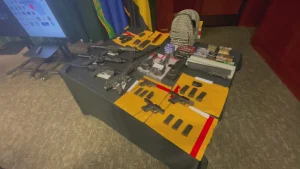
Illicit firearms do appear on dark-net markets, though research suggests that volume is small compared with drugs, yet the security impact is high. RAND’s multi-country study documented listings for firearms, parts, and explosives; Europol flags persistent monitoring of dark web cartels weapons flows. RAND Corporation+1Europol
Dark web cartels and brokers route proceeds through exchanges, OTC brokers, mixers, and chain-hops. OFAC sanctioned mixers like Tornado Cash and Blender for laundering (including DPRK-linked hacks), then delisted Tornado Cash in March 2025 after litigation—while criminal cases continued in parallel. A Manhattan jury last week convicted co-founder Roman Storm on one count (operating an unlicensed money-transmitting business) and hung on laundering/sanctions charges. Meanwhile, Chainalysis reports cybercriminal flows have shifted toward stablecoins overall; darknet markets have also swung back toward Bitcoin after major exchanges delisted Monero, according to on-chain analysts. Department of Justice+1U.S. Department of the TreasuryThe Wall Street JournalChainalysisCoinDesk
Receipts: U.S. agents seized $10M in cartel-linked crypto in July 2025, underscoring that “anonymous” isn’t the same as “untraceable.” CBS News
UNODC and Europol describe traffickers’ use of modern communications, recruitment, control, and payments across the open web, encrypted apps, and (in limited cases) dark-net services. The digital layer complicates investigations and victim identification, but targeted actions have identified victims and suspects via online platforms. UNODCEuropol+1
Dark web cartels sell torture and murder for huge profits. A network of gore platforms and private channels packages real-world killings and other graphic violence as paid content, using a mix of subscriptions, crypto “folders,” and ad inventory that skews toward adult sites.
Bottom line: The profitable part isn’t staged live-streamed torture—it’s the systematic resale, subscription-gating, and ad-monetization of real killings and extreme violence across a loose ecosystem that’s trivial to find and hard to shut down. (ASIS International)
Big international strikes matter: Silk Road (2013), AlphaBay/Hansa (2017), Hydra (2022), SpecTor (2023), and RapTor (June 2025) collectively took down markets, seized funds, and harvested data that seeded the next wave of cases. Each operation shows how multi-year infiltration and cross-border coordination pay off—even if three new sites bloom for every one cut down. WIREDArs TechnicaU.S. Department of the TreasuryFederal Bureau of InvestigationEuropol
This isn’t just crime, it’s platformization. The same UX patterns that power legitimate e-commerce supercharge illicit trade with scale, data, and risk-reduction for sellers. Crypto doesn’t eliminate trails; it rearranges them, often into ledgers cops can follow. The contest is iterative: takedown, regroup, rebuild.
Read more crucial missing person news and alerts on The Missing.org